
Understanding Property Values: A Buyer's Guide for 2026
Learn how to evaluate property values like a pro. Understand comps, adjustments, and market factors that determine fair pricing.

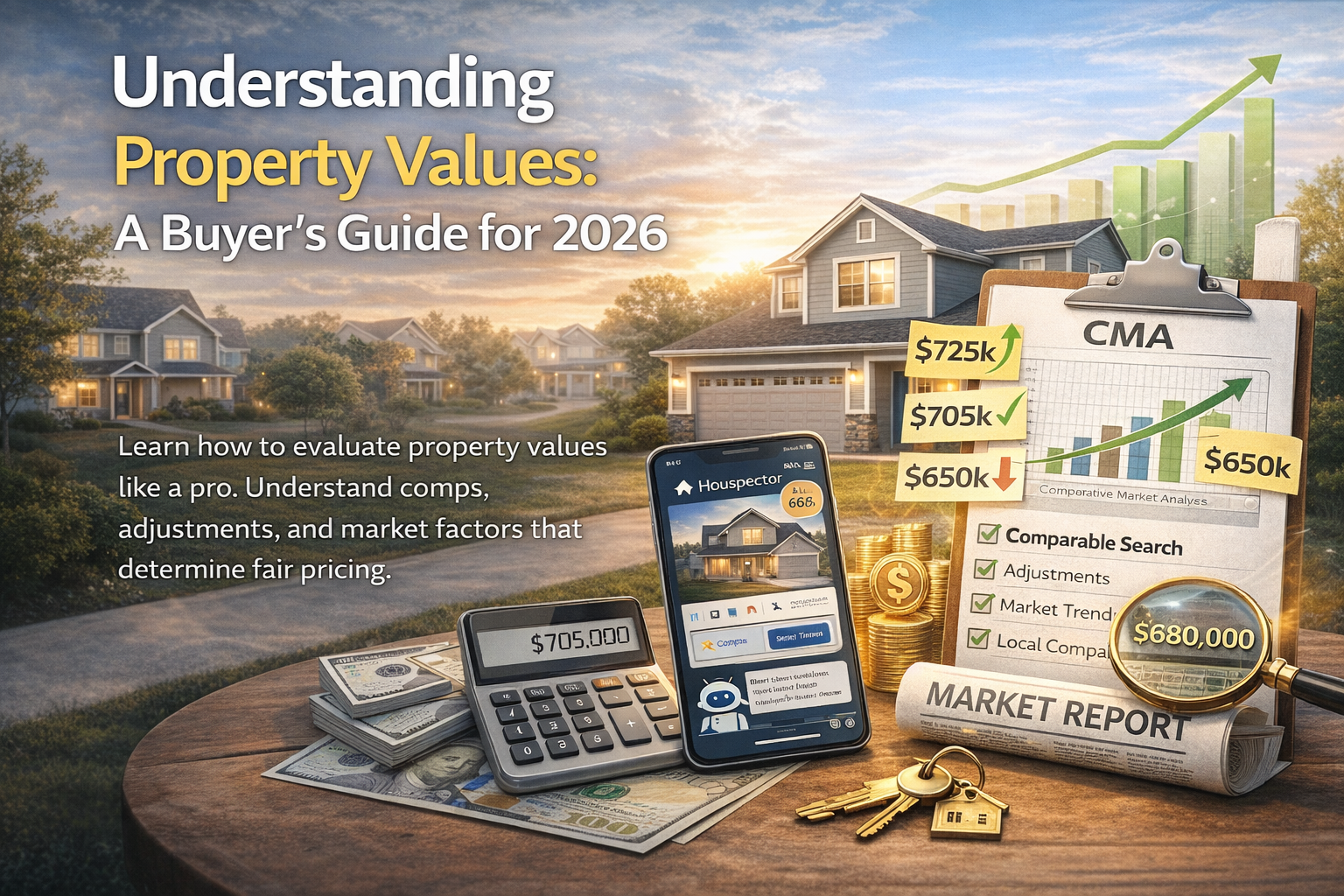
One of the biggest fears for home buyers is overpaying. But how do you know if a home is fairly priced? This guide breaks down the factors that determine property values and gives you practical tools to evaluate any listing.
Why Property Valuation Matters
Overpaying by even 5-10% can cost you tens of thousands of dollars and affect your ability to build equity. Understanding property values helps you:
- Make competitive but fair offers
- Negotiate with confidence
- Avoid properties that won't appreciate
- Build equity faster
- Ensure you can refinance or sell later if needed
💡 Houspector Tip: Our AI instantly analyzes property values by comparing recent sales, market trends, and neighborhood data—giving you confidence in every offer you make.
The 7 Key Factors That Determine Property Value
Is Now the Right Time?
1. Location, Location, Location
Why it matters most: You can renovate a house, but you can't change its location. Location accounts for 50-70% of a property's value.
What makes a location valuable:
- School districts: Top-rated schools add 10-20% to home values
- Commute times: Every 10 minutes closer to major employment centers adds value
- Walkability: Walk Score above 70 correlates with higher values
- Safety: Low crime rates are essential for value retention
- Amenities: Proximity to parks, shopping, restaurants
- Future development: Planned infrastructure improvements increase value
Red flags: Proximity to highways, industrial areas, power lines, or declining neighborhoods
💡 Houspector Tip: We automatically score neighborhoods based on schools, safety, walkability, and future development plans—helping you identify the best locations for long-term value.
2. Comparable Sales (Comps)
What they are: Recently sold homes similar to the one you're considering
How to use comps effectively:
- Look for sales within the last 3-6 months (more recent = more relevant)
- Focus on homes within 0.5 miles in similar neighborhoods
- Match square footage within 10-15%
- Compare same number of bedrooms/bathrooms
- Consider age and condition
Calculate price per square foot: Sale price ÷ square footage = $/sq ft
Example: If comparable homes sold for $250-$275/sq ft, a 2,000 sq ft home should be priced around $500,000-$550,000
Adjustment factors:
- Updated kitchen/bathrooms: +$10,000-$30,000
- Finished basement: +$15,000-$40,000
- Pool: +$10,000-$25,000 (varies by region)
- Garage: +$5,000-$15,000 per space
- Lot size: Larger lots add value in suburban areas
💡 Houspector Tip: Our AI finds and analyzes the most relevant comps automatically, adjusting for differences in features, condition, and market timing—giving you an accurate valuation in seconds.
3. Property Condition and Age
How age affects value:
- New construction (0-5 years): Premium pricing, modern systems, warranties
- Modern (6-20 years): Good condition, minimal major repairs needed
- Established (21-50 years): May need updates, systems approaching end of life
- Older (50+ years): Character and charm, but expect higher maintenance
Major systems to evaluate:
- Roof: 15-25 year lifespan, replacement costs $8,000-$25,000
- HVAC: 12-15 year lifespan, replacement costs $5,000-$12,000
- Water heater: 8-12 year lifespan, replacement costs $1,000-$3,000
- Windows: 15-20 year lifespan, replacement costs $300-$1,000 per window
- Siding: 20-40 year lifespan depending on material
Deduct from value: If major systems need replacement soon, factor those costs into your offer
💡 Houspector Tip: We flag properties with aging systems and estimate replacement costs, helping you avoid unexpected expenses and negotiate better prices.
4. Market Conditions
Seller's Market (low inventory, high demand):
- Homes sell quickly (under 30 days)
- Multiple offers common
- Prices at or above asking
- Fewer contingencies accepted
- You may need to offer 5-10% over asking in competitive situations
Buyer's Market (high inventory, low demand):
- Homes sit longer (60+ days)
- Fewer competing offers
- Prices negotiable, often below asking
- Sellers more willing to make repairs
- You can offer 5-10% below asking and negotiate
Balanced Market:
- Homes sell in 30-60 days
- Prices close to asking (within 2-3%)
- Fair negotiation on both sides
How to identify your market: Check "months of inventory" - under 3 months = seller's market, over 6 months = buyer's market
💡 Houspector Tip: We track real-time market conditions in your target neighborhoods, showing you whether it's a buyer's or seller's market and how aggressively you need to offer.
5. Size and Layout
Square footage matters, but so does usability:
- Open floor plans command premium prices
- Master bedroom on main floor adds value (especially for aging buyers)
- Functional layouts worth more than awkward spaces
- Finished basements add value but less than main-level space
Bedroom/bathroom count:
- 3 bed/2 bath is the minimum for most buyers
- 4 bed/2.5+ bath is the sweet spot for families
- 5+ bedrooms have smaller buyer pool (may limit resale)
- Each additional bathroom adds 5-10% to value
6. Lot Size and Outdoor Space
Urban areas: Lot size less important, focus on outdoor living spaces (deck, patio)
Suburban areas: Larger lots command premium, especially 0.5+ acres
Rural areas: Acreage is major value driver
Value-adding outdoor features:
- Fenced yard: +$3,000-$8,000
- Deck or patio: +$5,000-$15,000
- Landscaping: +$2,000-$10,000
- Pool: Varies widely by region (can be neutral or negative in some areas)
7. Unique Features and Upgrades
High-ROI upgrades that add value:
- Kitchen remodel: Adds 60-80% of cost to value
- Bathroom remodel: Adds 60-70% of cost to value
- Hardwood floors: Adds 70-80% of cost to value
- Energy-efficient windows: Adds 70-75% of cost to value
- Smart home features: Adds 3-5% to value
Low-ROI features (don't overpay for these):
- Swimming pools (except in warm climates)
- Over-the-top luxury finishes
- Home theaters or specialty rooms
- Extensive landscaping (you won't recoup full cost)
How to Evaluate a Listing Price
Step 1: Research comparable sales
Find 3-5 similar homes sold in the last 6 months. Calculate average price per square foot.
Step 2: Adjust for differences
Add or subtract value based on condition, upgrades, lot size, and location differences.
Step 3: Consider market conditions
In a hot market, expect to pay closer to (or above) asking. In a slow market, you have negotiating room.
Step 4: Factor in days on market
- Under 7 days: Likely priced well or underpriced
- 7-30 days: Fair market price
- 30-60 days: May be slightly overpriced
- 60+ days: Likely overpriced or has issues
Step 5: Check price history
Has the price been reduced? Multiple reductions suggest the seller is motivated and the original price was too high.
💡 Houspector Tip: We do all this analysis automatically for every property you view, showing you whether it's fairly priced, overpriced, or a potential deal.
Common Valuation Mistakes to Avoid
Mistake #1: Relying only on Zillow Zestimates
Zestimates have a median error rate of 2-3%, but can be off by 10%+ in some cases. Use them as a
starting point, not the final word.
Mistake #2: Ignoring market trends
A comp from 6 months ago may not reflect current market conditions if prices are rising or
falling rapidly.
Mistake #3: Overvaluing cosmetic updates
Fresh paint and new carpet are nice, but don't add significant value. Focus on structural
condition and major systems.
Mistake #4: Emotional attachment
Falling in love with a home can cloud your judgment. Stick to your budget and valuation
analysis.
Mistake #5: Forgetting future resale
Even if you plan to stay long-term, consider resale value. Avoid homes with features that limit
buyer appeal.
Tools to Help You Evaluate Property Values
Free resources:
- Zillow, Redfin, Realtor.com for comps and market data
- County assessor websites for tax assessments
- GreatSchools.org for school ratings
- Walk Score for neighborhood walkability
- Flood maps (FEMA) for flood risk
Professional help:
- Real estate agent (free for buyers - seller pays commission)
- Professional appraiser ($300-$500)
- Home inspector ($300-$500)
AI-powered analysis with Houspector:
Houspector analyzes all these factors instantly, giving you:
- Automated comp analysis
- Market trend insights
- Neighborhood value predictions
- Risk assessment for overpricing
- Personalized recommendations based on your criteria
Making Your Offer
If the home is fairly priced: Offer asking price or slightly below (2-3%) with standard contingencies
If the home is overpriced: Offer based on comps, not asking price. Be prepared to walk away if seller won't negotiate
If the home is underpriced: In competitive markets, you may need to offer above asking. Set your max price based on value, not emotion
Always include:
- Home inspection contingency
- Financing contingency (unless you're paying cash)
- Appraisal contingency (protects you if home doesn't appraise)
💡 Houspector Offer Strategy: Based on our analysis, we recommend specific offer amounts and negotiation strategies tailored to each property and market condition.
Final Thoughts
Understanding property values isn't about finding the cheapest home—it's about paying a fair price for the value you're getting. Do your research, trust the data, and don't let emotions override your analysis.
Remember: The best deal isn't always the lowest price. It's the right home, in the right location, at a fair price that fits your budget and goals.
Try Houspector free to get instant property valuations and market analysis for any home you're considering. Our AI does the heavy lifting so you can make confident decisions.